Testing Blog
A Virtual Battlefield... with Bugs: Ship Wars @ Google Kirkland
Thursday, November 8, 2012
By Anthony F. Voellm (aka Tony the
@p3rfguy
/
G+
) and Emily Bedont
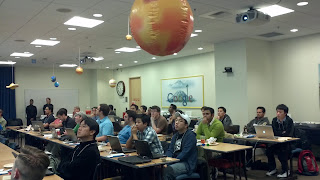
On Wednesday, October 24th, while sitting under the Solar System, 30 software engineers from the Greater Seattle area came together at
Google Kirkland
to partake in the first ever Test Edition of
Ship Wars
. Ship Wars was created by two
Google Waterloo
engineers, Garret Kelly and Aaron Kemp, as a 20% project. Yes, 20% time does exist at Google! The object of the game is to code a spaceship that will outperform all others in a virtual universe - algorithm vs algorithm.
The Kirkland event marked the 7th iteration of the program which was also recently done in NYC. Kirkland however was the first time that the game had been customized to encourage exploratory testing. In the case of "Ship Wars the
Test Edition
," we planted 4 bugs that the engineering participants were awarded for finding. Well, we ran out of prizes and were quickly reminded that when you put a lot of testing minded people in a room, many bugs will be unveiled! One of the best unveiled bugs was not one of the four planted in the simulator. When turning your ship 90 degrees, the ship actually turned -90 degrees. Oops!
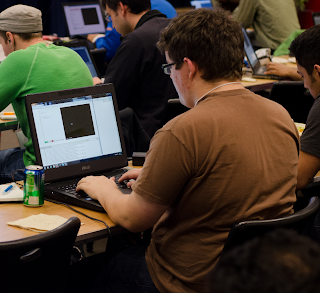
Participants were encouraged to test their spaceship built on their own machine or a Google Chromebook. While the coding was done in the browser, the simulator and web server were run on
Google Compute Engine
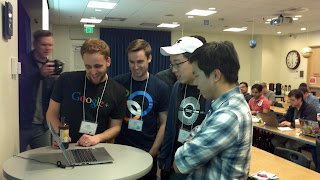
. Throughout the 90 minutes, people challenged other participants to duels. Head-to-head battles took place on Chromebooks at the front of the room. There were many accolades called out but in the end, there could only be one champion who would walk away with a brand spankin’ new Nexus7. Check out our
video
of the evening’s activities.
Sounds fun, huh? We sure hope our participants, including our first place winner shown receiving the Nexus 7 from Garret, enjoyed the evening! Beyond the battles, our guests were introduced to the revived
Google Testing Blog
, heard firsthand that
GTAC
will be back in 2013, learned about testing at Google, and interacted with Googlers in a "Googley" environment. Achievement unlocked.
Special thanks to all the Googlers that supported the event!
Testing 2.0
Thursday, August 30, 2012
By Anthony F. Voellm (aka Tony the perfguy)
It’s amazing what has happened in the field of test in the last 20 years... a lot of “art” has turned into “science”. Computer scientists, engineers, and many other disciplines have worked on
provable systems and calculus
,
pioneered model based testing
, invented
security fuzz testing
, and even settled on a common pattern for unit tests called
xunit
. The xunit pattern shows up in open source software like JUnit as well as in Microsoft development
test tools
.
With all this innovation in test, there’s no wonder
test is dead
. The situation is no different from the late 1800’s when
patents were declared dead
. Everything had been invented. So now that everything in test has been invented, it’s dead.
Well... if you believe everything in test has been invented then please stop reading now :)
As an aside: “
Test is dead
” was a keynote at the Google Test Automation Conference (GTAC) in 2011. You can watch that talk and many other GTAC test talks on YouTube, and I definitely recommend you check them out
here
. Talks span a wide range of topics ranging from
GUI Automation
to
Cloud
.
What really excites me these days is that we have closed a chapter on test. A lot of the foundation of writing and testing great software has been laid (examples at the beginning of the post, tools like Webdriver for UI, FIO for storage, and much more), which I think of as Testing 1.0. We all use Testing 1.0 day in and day out. In fact at Google, most of the developers (called Software Engineers or SWEs) do the basic Testing 1.0 work and we have a high bar on quality.
Knuth
once said "Be careful about using the following code -- I've only proven that it works, I haven't tested it."
This brings us to the current chapter in test which I call Testing 1.5. This chapter is being written by computer scientists, applied scientists, engineers, developers, statisticians, and many other disciplines. These people come together in the Software Engineer in Test (
SET
) and Test Engineer (TE) roles at Google. SET/TEs focus on; developing software faster, building it better the first time, testing it in depth, releasing it quicker, and making sure it works in all environments. We often put deep test focus on Security, Reliability and Performance. I sometimes think of the SET/TE’s as risk assessors whose role is to figure out the probability of finding a bug, and then working to reduce that probability. Super interesting computer science problems where we take a solid engineering approach, rather than a process oriented / manual / people intensive based approach. We always look to scale with machines wherever possible.
While Testing 1.0 is done and 1.5 is alive and well, it’s Testing 2.0 that gets me up early in the morning to start my day. Imagine if we could reinvent how we use and think about tests. What if we could automate the complex decisions on good and bad quality that humans are still so good at today? What would it look like if we had a system collecting all the “quality signals” (think: tests, production information, developer behavior, …) and could predict how good the code is today, and what it most likely will be tomorrow? That would be so awesome...
Google is working on Testing 2.0 and we’ll continue to contribute to Testing 1.0 and 1.5. Nothing is static... keep up or miss an amazing
ride
.
Peace.... Tony
Special thanks to Chris, Simon, Anthony, Matt, Asim, Ari, Baran, Jim, Chaitali, Rob, Emily, Kristen, Annie, and many others for providing input and suggestions for this post.
Labels
Aaron Jacobs
1
Adam Porter
1
Alan Faulkner
1
Alan Myrvold
1
Alberto Savoia
4
Alek Icev
2
Alex Eagle
1
Allen Hutchison
6
Andrew Trenk
8
Android
1
Anthony Vallone
25
Antoine Picard
1
APIs
2
App Engine
1
April Fools
2
Arif Sukoco
1
Bruce Leban
1
C++
11
Chaitali Narla
2
Christopher Semturs
1
Chrome
3
Chrome OS
2
Dave Chen
1
Diego Salas
2
Dmitry Vyukov
1
Dori Reuveni
1
Eduardo Bravo Ortiz
1
Ekaterina Kamenskaya
1
Erik Kuefler
3
Espresso
1
George Pirocanac
2
Google+
1
Goranka Bjedov
1
GTAC
54
Hank Duan
1
Harry Robinson
5
Havard Rast Blok
1
Hongfei Ding
1
James Whittaker
42
Jason Arbon
2
Jason Elbaum
1
Jason Huggins
1
Java
5
JavaScript
7
Jay Han
1
Jessica Tomechak
1
Jim Reardon
1
Jobs
14
Joe Allan Muharsky
1
Joel Hynoski
1
John Penix
1
John Thomas
3
Jonathan Rockway
1
Jonathan Velasquez
1
Julian Harty
5
Julie Ralph
1
Karin Lundberg
1
Kaue Silveira
1
Kevin Graney
1
Kirkland
1
Kurt Alfred Kluever
1
Lesley Katzen
1
Marc Kaplan
3
Mark Ivey
1
Mark Striebeck
1
Marko Ivanković
1
Markus Clermont
3
Michael Bachman
1
Michael Klepikov
1
Mike Wacker
1
Misko Hevery
32
Mobile
2
Mona El Mahdy
1
Noel Yap
1
Patricia Legaspi
1
Patrick Copeland
23
Patrik Höglund
5
Peter Arrenbrecht
1
Phil Rollet
1
Philip Zembrod
4
Pooja Gupta
1
Radoslav Vasilev
1
Rajat Dewan
1
Rajat Jain
1
Rich Martin
1
Richard Bustamante
1
Roshan Sembacuttiaratchy
1
Ruslan Khamitov
1
Sean Jordan
1
Sharon Zhou
1
Shyam Seshadri
4
Simon Stewart
2
Stephen Ng
1
Tejas Shah
1
Test Analytics
1
Tony Voellm
2
TotT
54
Vojta Jína
1
WebRTC
2
Yvette Nameth
2
Zhanyong Wan
6
Zuri Kemp
2
Archive
2015
December
GTAC 2015 Wrap Up
November
October
August
June
May
April
March
February
January
2014
December
November
October
September
August
July
June
May
April
March
February
January
2013
December
November
October
August
July
June
May
April
March
January
2012
December
November
October
September
August
2011
November
October
September
August
July
June
May
April
March
February
January
2010
December
November
October
September
August
July
June
May
April
March
February
January
2009
December
November
October
September
August
July
June
May
April
February
January
2008
December
November
October
September
August
July
June
May
April
March
February
January
2007
October
September
August
July
June
May
April
March
February
January
Feed
Follow @googletesting